Era of Web Building Removed One More Barrier

There's a specific kind of pain that every early web developer knows. You've spent three hours positioning a div. It looks perfect in Chrome. You check Firefox, it's broken. You check IE it doesn't exist. You go back to your code, tweak a margin by 2px, reload. Still
broken. You open Stack Overflow. You close Stack Overflow. You stare at the screen. It's 1 AM.
That was web building for a long time deeply powerful, deeply exclusionary, and deeply, inexplicably, satisfying.
Today, someone can describe what they want in plain English and have a working, animated, SEO-ready website live in under an hour without opening a single code editor. That's not an incremental improvement. That's a full civilizational shift in who gets to build things on the internet, and how.
This is the story of how we got here.
The Old World: Websites Were Reserved for the Fluent
Before 2005 or so, building a website meant fluency in at least three languages: HTML for structure, CSS for style, and JavaScript for anything interactive. Those were just the front-end basics. A database, forms that were actually submitted, or user logins meant PHP, MySQL, Python, or worse. The barrier wasn't a learning curve. It was a cliff face.
Most businesses either hired expensive developers, paid agencies tens of thousands for a site that took months, or simply stayed offline. The internet was built by a small class of people who could read and write machine-adjacent syntax. The ideas were never the bottleneck. The code was.
That friction is what the no-code movement set out to destroy.
The Conditions That Made No-Code Inevitable
Revolutions don't happen because someone has a great idea. They happen when the infrastructure finally catches up.
Earlier generations of visual builders never truly took off because the conditions weren't right: browsers were slow, cloud was expensive, connectivity was patchy, and clean APIs were rare. By the 2010s all four had changed at once. Browsers became powerful, cloud became cheap, 4G made connectivity near-universal, and every serious platform exposed usable interfaces that anyone could hook into.
The Rapid Application Development movement of the 1980s had tried to simplify programming so developers could move faster but it was still making tools for developers. The modern no-code era did something different: it abstracted the entire act of coding into visual, drag-and-drop interfaces. You weren't writing HTML anymore. You were producing it by dragging a text block onto a canvas.
The Tools That Opened the Door
The timeline of what arrived is worth knowing. Shopify launched in 2006 and gave anyone the ability to run an online store with zero coding. Bubble followed in 2012 as the first true no-code web application platform. Webflow arrived in 2013 and, for designers especially, felt like a superpower: full visual control with clean, exportable code underneath.
Wix, launched the same year as Shopify, played a quieter but broader role. While more design-forward tools required a certain visual fluency, Wix lowered the floor further. Its freemium, template-first, browser-based editor made it possible for freelancers, local businesses, artists, and side projects to get online without design training or developer budgets. It was never the most elegant platform, and critics had fair points about performance and lock-in. But it pulled millions of people onto the web who would otherwise have stayed offline or paid agencies. Later, its early moves into AI-assisted building (ADI and beyond) put it ahead of many peers in the shift from configuration to description. Alongside Squarespace and others, it helped turn website ownership from a specialist skill into something closer to a default.
No-Code's Real Scope Was Never Just Websites
Most people still think of no-code as "how you build a site without coding." That is the smallest version of the story.
The real expansion was in what counted as building. Airtable turned database management into something that looked like a spreadsheet. Zapier lets anyone connect apps with if-then logic. Notion made documentation itself a product. Figma changed how designers and developers worked together long before it began generating code.
And then there is Excel.
Underrated, unglamorous, and quietly the most powerful no-code platform ever built, Excel has been running business logic, financial models, inventory systems, and dashboards for decades. Before anyone called it "no-code," it was letting non-technical people construct complex, functional systems. Formulas, pivot tables, conditional formatting, and macros form a genuine programmable layer without traditional code. Millions of businesses still run on sheets that would take a development team weeks to replicate. That is what happens when you give people a flexible building block with a low floor and a high ceiling.
The Loomery team once ran their entire company operations on Airtable while their website lived in Webflow built in 48 hours. A community app for NorthEdge took two weeks with Adalo. The real pitch of no-code was never perfection. It was a dramatic compression of time.
The Problem No-Code Never Quite Solved
No-code had a dirty secret: it was not a zero learning curve. It was a different learning curve.
Every platform carried its own logic, its own interface quirks, and its own way of handling anything slightly off-template. Webflow rewarded people who already thought in CSS. Bubble demanded mastery of its database and workflow model before anything non-trivial became possible. Switching tools often felt like starting over.
More fundamentally, you were at the mercy of the company providing the tool. Pricing changes, acquisitions, or shutdowns could break the structure of a product overnight. Tools were limited to the features they shipped, grew expensive beyond starter plans, and remained vulnerable to single-platform updates that left builders stranded.
You traded syntax frustration for platform frustration. Different walls, same room. Wix users knew this tension especially well: accessibility came with the constant awareness that the foundation sat on someone else's servers and roadmap.
AI Didn't Just Add a Feature It Changed the Constraint
The shift from no-code to AI-native building is not another incremental upgrade. It changes what the constraint is.
With no-code you were limited by what the platform offered. With AI tools you are limited by your understanding of what is possibly a fundamentally more expansive ceiling.
Platforms such as v0 by Vercel, Cursor, and Lovable began reading intent rather than instructions. You no longer configure. You describe. "Build me a landing page for a premium skincare brand with a dark aesthetic, an animated hero section, and a product carousel." The result is not an approximation. It is a working starting point.
Claude working inside design ecosystems can generate structured, animated sites from plain description. Reference-image tools can analyze a live site or an existing brand identity and rebuild from it, keeping visual language intact. Even mundane tasks that once required fiddling with table-based email layouts or custom plugins now collapse into a single prompt.
The strongest of these tools also carried forward no-code DNA: direct element editing, design tokens, and stored systems the model learns to respect. Visual control where you want it. Generative power where you need it.
What the Arc Actually Tells Us
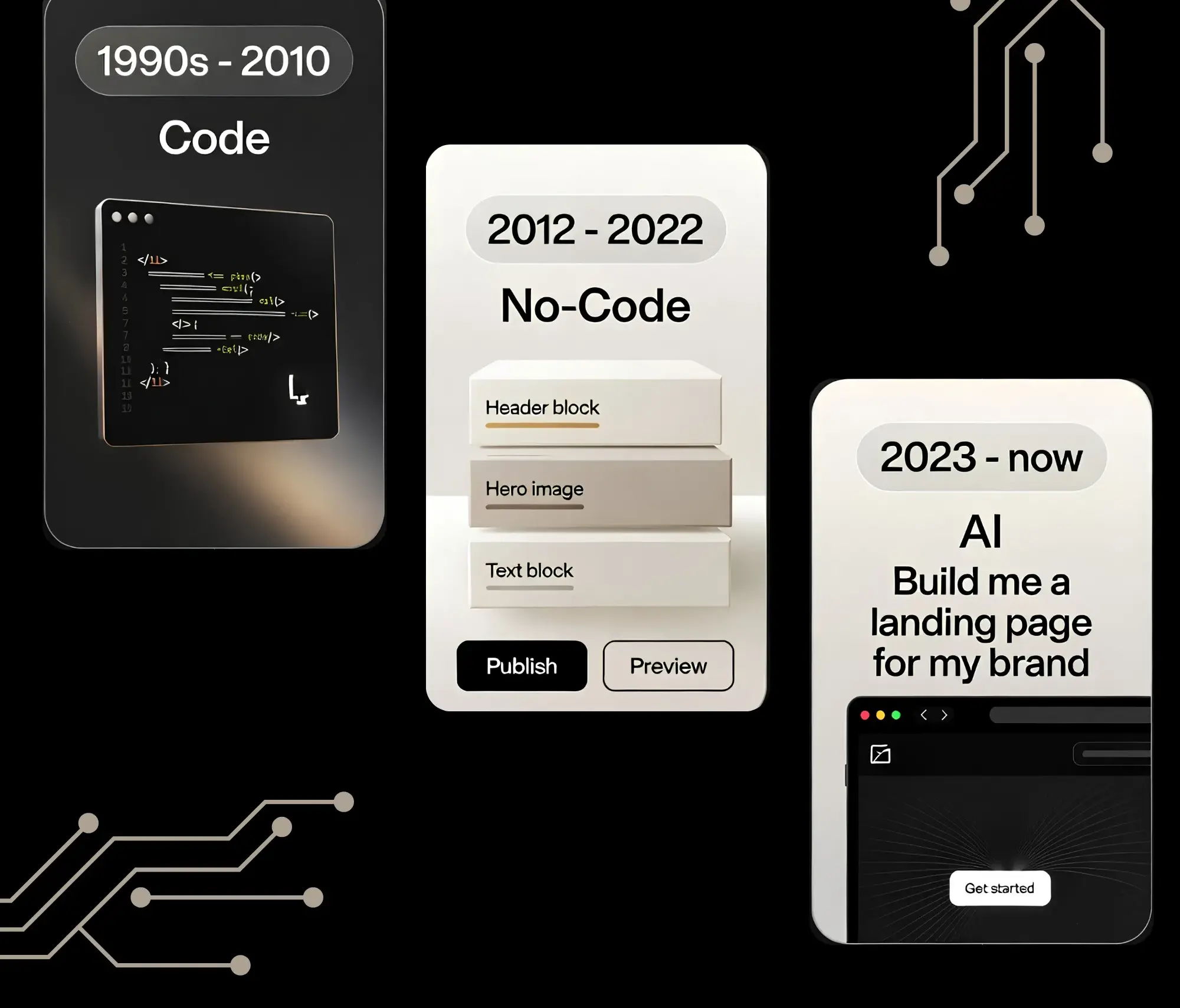
Looking at the full journey from raw HTML to drag-and-drop to AI generation one constant remains. The constraint keeping ordinary people from building has always been technical fluency, and each era has removed one more layer of that requirement.
Traditional coding was the baseline. No-code removed the need for syntax. AI is now removing the need for interface literacy. You no longer need to know how a particular builder thinks about layouts. You only need to know what you want.
The next question the one no one has fully answered is what happens when even knowing what you want becomes easier to articulate. When the system can suggest directions you had not considered, test them, and iterate without being asked.
That is no longer a website builder. That is something else entirely.
We are probably eighteen months from finding out what to call it.
Sources & further reading: Wix Blog (Jenna Romano), Loomery (Tim Checkley), Webnode, Punit Chawla’s writing on Medium, and contemporary reporting on the evolution of visual and generative web tools.
Comments